Posts

Showing posts with the label Power of Attorney

Another Cautionary Tale for Power of Attorney Agents and Self-dealing

Image
The Illinois Appellate Court 4th District case of Collins v. Noltensmeier provides an example of why power attorney agents need to tread very carefully when giving gifts to themselves.  After the principal (Billy) passed away, the case arose as a dispute between Billy's brother and niece (plaintiffs) and his long-term girlfriend/partner Patricia who also acted as his caretaker. Billy signed a will and power of attorney for property (using the statutory short form ) about a week before he passed away, naming Patricia as his POA agent, executor and sole beneficiary in his will. After Billy died and Defendant filed his will with the court, plaintiffs filed a will contest and a separate case against defendant for breach of fiduciary duty and wrongful conversion of Billy's IRA.  Apparently Patricia acting as POA agent for Billy had changed the beneficiary of his IRA, to herself. In court, Patricia defended herself by citing the wording of the Illinois statutory POA form, whi...

Trustees, Executors, Guardians and POA Agents - Your Accounting Cometh. Be prepared!!!

Image
In the recent case In Re: Estate of Lee , the Illinois Appellate Court , Third District, reviewed orders from the trial court requiring an accounting from the trustee, finding contempt for failure to comply by the deadline in the court order for the accounting, ordering the executor to bypass the trustee and make payments direct to the beneficiaries, and removing the trustee.  The appellate court affirmed the court orders, except reversing the contempt ruling and sanctions. The decedent (Sandra) died in 2005, leaving three minor children. She had a will that (in a common estate planning strategy for parents with minor children) included a testamentary trust as the means by which her children would receive their inheritance, and providing that each child would receive 1/3 of the trust assets at the age of 25.  The will appointed an executor (Jennifer) and a trustee (Kathleen) who appears to also have served as guardian (the opinion indicates the children lived with Kathl...

Illinois Supreme Court Clarifies POA Fiduciary Duties

Image
The recent ruling of the Illinois Supreme Court , In re Estate of Thomas F. Shelton , presents the sad tale of a dispute between siblings over a family farm, and the fiduciary duties required of power of attorney agents.  Mr. and Mrs. Shelton both passed away in 2012.  Each named their daughter as executor of their estates, but in a "divide and conquer" approach to naming fiduciaries that is not uncommon for those with more than one adult child, Mr. and Mrs. Shelton named each other as primary agent for Power of Attorney for Property or financial matters, and their son as backup agent (the daughter was named as the second backup). (The opinion does not specify, but it is likely they each named each other as first choice for executor, but the backup order was reversed as to the son and daughter).  The POAs were signed in 2005, using the "statutory short form" POA for Property .  Fast forward then to late 2011, approximately one year before the death of both Mr...

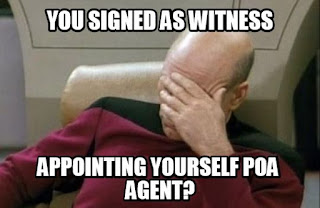
No, You Can't Sign as the Witness on a Power of Attorney Appointing Yourself as Agent!

Image
I recently received a call on behalf of a former client who had apparently suffered some serious medical issues.  The gentleman who called informed me that, since I last communicated with the former client, he had signed a new Power of Attorney for Property ("POA") appointing the caller his agent.  He told me that they had not worked with an attorney in preparing this new POA but just "found one online." The agent sought to review/obtain a copy of the former client's file at my office, including his estate planning documents.  I asked the agent to send me a copy of the new POA so I could take a look at it. When I reviewed the new POA document, I saw the typewritten provision where the former client named the caller his agent.  I then checked to ensure the document had been signed by the principal, witnessed and notarized properly.   There were two attesting witnesses who signed the document - the named agent himself and his spouse (the spouse was also named...

Illinois Disposition of Remains Act and Health Care Power of Attorney

Image
As mentioned in our previous post , the Illinois Statutory Short Form Power of Attorney for Health Care was recently amended.  The new form provides the agent has authority over four general issues, including: "(iv) Carrying out the plans I have already made, or, if I have not done so, making decisions about my body or remains, including organ, tissue or whole body donation, autopsy, cremation, and burial."    The same section of the statute, after the form, further states that the agent is presumed to have authority "...to direct the disposition of the principal's remains."   755 ILCS 45/4-10 .   However, Illinois also has a "Disposition of Remains Act," found at 755 ILCS 65/1 , et. seq.  This statute contains a list of persons having priority to make such decisions, UNLESS the deceased left directions in one of a number of possible writings, one of which is a Power of Attorney for Health Care.  The statute does NOT provide for any of ...

Illinois Estate Planning Law Changes for 2015 - Health Care Power of Attorney Statutory Short Form

Image
January 1, 2015 ushered into law several significant changes to Illinois estate planning law.  In this series, we'll take a look at some of them and how these changes might affect your estate plan.  Let's begin by taking a look at a very important part of every estate plan - the Power of Attorney Act .   Unlike a Will, a Power of Attorney authorizes someone (your "agent") to act on your behalf while you are still living. The Illinois Power Attorney Act, 755 ILCS 45, has four Articles. The Title (Article I), Durable Powers of Attorney (Article II), the Statutory Short Form POA for Property (Article III), and Powers of Attorney for Health Care (Article IV).  Article IV is the only one that was changed effective January 1, 2015 (there were a few changes to Article II made effective in July 2014) and is the focus of this post. The Health Care Article IV of the Power of Attorney Act contains a Statutory Short Form Health Care POA within it, and this form was c...

Ask a Lawyer - Why Should I Retain an Attorney to Help with My Will or Trust?

Image
This is a common question and has multiple layers to it.  To give a complete answer, I will break it out into three questions, and answer the latter two parts in future posts: 1.  What is "estate planning" and why should I have an estate plan (a/k/a, isn't that just for the "rich")? 2.  Why do I need a Will, and what happens if I die without a Will? 3.  Even if I need a Will, why shouldn't I just do it myself, or order one off a website? Appropriately answering number 1 first, an estate plan is really the process of considering what will happen when you die or are incapacitated.  This involves financial considerations, such as how your assets will be distributed, via wills, trusts, probate, and other non-probate assets such as life insurance; who will inherit family heirlooms; how taxes, debts, and expenses will be handled; and who will direct your affairs.  It also involves personal, family considerations, such as who will take care of your kids...